Project 180 is confronting the Presbyterian colonial legacy in Liberia through truth-telling, apology, repair, and renewed relationships with Indigenous Liberians.
By Beth Waltemath, Presbyterian News Service | August 14, 2026
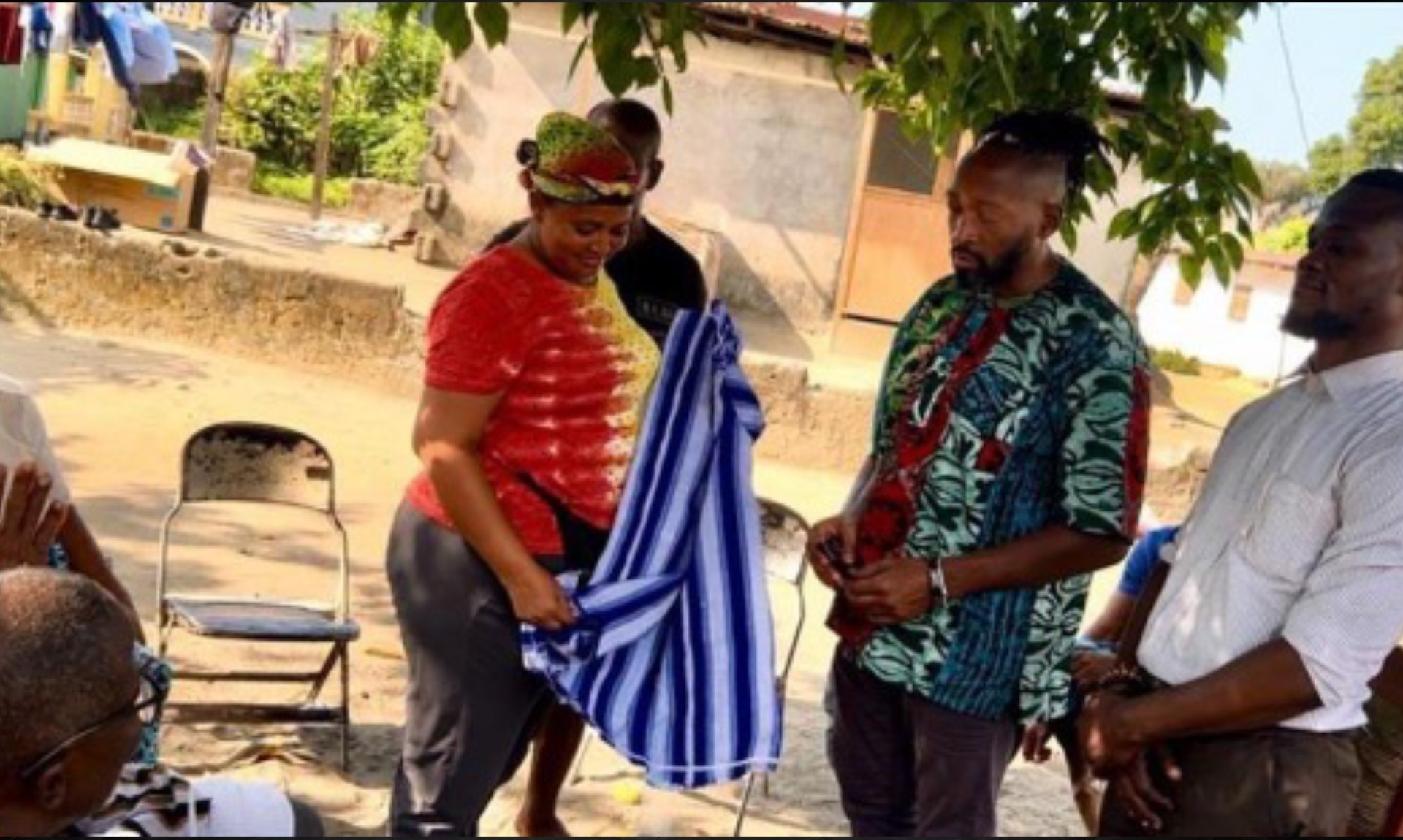
Featured image: Indigenous elders in Liberia welcome the Rev. Jermaine Ross-Allam with the gift of a woven garment in 2025. Photo by James Norman.
The Presbyterian Colonial Legacy in Liberia
More than two centuries after Presbyterians helped launch and support the American Colonization Society, leaders of the Presbyterian Church (U.S.A.) are beginning a process of truth-telling, apology and repair centered on the indigenous Liberian communities most affected by the colony that became the Republic of Liberia.
Approved by the 227th General Assembly through the consent agenda as RAC-03, Liberia Project 180 calls Presbyterians to examine the denomination’s historical involvement in colonization while creating new relationships with indigenous Liberians to discern the living legacies of Presbyterians’ role in Liberia’s colonial founding.
Why Project 180 Centers Indigenous Liberians
“The reparative focus is between Presbyterians and indigenous Liberians because indigenous Liberians are the people first and worst impacted by Presbyterians’ decision to co-found the American Colonization Society,” said the Rev. Jermaine Ross-Allam, director of the Center for the Repair of Historic Harms, who contributed the Liberia Project 180 Report that accompanied the rationale for RAC-03.
Ross-Allam argues that understanding Liberia’s history requires U.S. residents to look beyond familiar narratives about emancipation and settlement and confront the political and theological assumptions that shaped colonization itself. Drawing on historical scholarship included in the rationale, he notes that the American Colonization Society emerged in the aftermath of the Haitian Revolution and amid growing anxiety among white political and religious leaders about the future of free Afro-descended people in the United States.
Related UMI coverage: mission without racism and colonial assumptions.
“The theological damage that we are seeking to repair is part of a consistent pattern in the United States,” Ross-Allam said. “In the effort to get rid of rather than solve a problem, the church and the nation both make their refusal to solve their social, political and theological contradictions into someone else’s problem: in this case, indigenous Liberians first and foremost, and subsequently, the entirety of the Liberian people.”
The initiative’s rationale traces Presbyterian involvement to the founding of the American Colonization Society in 1816 through the efforts of Presbyterian minister Robert Finley and other supporters who promoted the relocation of free and emancipated Afro-descendants from the United States to West Africa. RAC-03’s report argues that colonization was advanced as an alternative to confronting slavery, racial hierarchy and the possibility of multiethnic democracy in the United States.
“Enslaved Afro-descendants and unenslaved Afro-descendants in the United States were removed from the United States after, in many cases, receiving a religious education on the very plantations where their families were still held as slaves,” Ross-Allam said, highlighting a frequently overlooked dimension of the colonization project: many settlers arrived in Liberia after receiving Christian instruction from the very churches and religious invested in a slaveholding society.
The resulting encounter between Afro-descendent settlers from the United States and indigenous Liberians shaped patterns of hierarchy, exclusion and conflict that reverberated throughout Liberian history. According to historian Jeremy I. Levitt, the American Colonization Society’s acquisition of land at Cape Mesurado involved coercion after repeated negotiations with indigenous leaders failed. Levitt describes American Colonization Society representative and United States Navy Officer Robert Field Stockton forcing agreement to the transaction at gunpoint after talks broke down in December 1821. Robert Field Stockton belonged to a prominent Princeton family and served on Princeton Theological Seminary’s Board of Directors.
“RAC-03 includes collaboration with Betsey Stockton Center for Black Church Studies at Princeton Theological Seminary for our theological repair work,” said Ross-Allam, who pointed out the connection between the Stocktons and Princeton. Betsey Stockton was enslaved by Robert Stockton, the great-uncle of U.S. Navy officer Robert Field Stockton, before being moved to serve the household of the newly married, Elizabeth Stockton Green and Rev. Asbel Green, pastor of Second Presbyterian Church and later the college president in 1812, before Stockton became a missionary and a teacher as an adult.
RAC-03’s rationale further cites Levitt’s assessment that the American Colonization Society operated as “an American pseudo-humanitarian association governed by white American slave owners” and argues that indigenous sovereignty was routinely subordinated to the goals of the settlement project.
Repairing the Presbyterian Colonial Legacy in Liberia
For Ross-Allam, these historical realities are essential to understanding why the church’s work must move beyond symbolic acknowledgment. “This initiative seeks to learn the truth about the above processes, learn from indigenous Liberians what repair requires, and create transgenerational relationships that will embody the solution so that the next 180 years will be nothing like the first 180 years.”
Related UMI coverage: African church reparations and decolonization efforts.
That vision is reflected in the resolution’s three primary initiatives. RAC-03 directs Presbyterian Life & Witness to work with Liberian and U.S. partners to explore a permanent transatlantic theological partnership, establish a transatlantic society for Christian youth of African descent, and develop a formal acknowledgment and apology regarding Presbyterian involvement in and support of the American Colonization Society. Recommendations from each effort will return to the 228th General Assembly in 2028.
Building a New Transatlantic Partnership
The project’s emphasis on apology and re-encounter is rooted not only in the experiences of indigenous Liberians but also in the complicated legacy inherited by descendants of formerly enslaved settlers. The final section of the Liberia Project 180 full report examines 19th-century letters written by Americo-Liberians to former enslavers and American Colonization Society supporters as documented in the book, “Slaves No More: Letters from Liberia, 1833 to 1869,” by Bell I. Wiley. According to Wiley, enslavers were seen as philanthropic for setting up a long installment plan governed by a “strict code of conduct,” wage penalties, and continued control over family freedom before turning those enslaved persons over to the ACS. The letters reveal the degree to which plantation-era assumptions about authority, civilization and Christian leadership continued to shape relationships in Liberia long after settlement.
In an 1844 letter, one Americo-Liberian woman addresses her former enslaver from Monrovia as “My Dear Reverend Father, Yes, my best benefactor on earth,” and proceeds by “reflecting upon what our good Lord has done for us, to provide us such a gentleman as you for our former master, you gave us our liberty, spent your treasure in giving or procuring us passages to this our now delightful country, and now condescend to write to us by the endearing apellaition [sic] of dear children.”
Ross-Allam said those records point toward a difficult but necessary conversation among Christians of African descent on both sides of the Atlantic.
“We need to do repairs, not just from the majority Presbyterian white folks to Liberians, but we also need to engage in specific acts of reconciliation and re-encounter between people of African descent who are Presbyterians here, and Liberian Presbyterians and indigenous people, because that’s part of the damage that was done.”
“This history warrants careful reading,” the Racial Equity Advocacy Committee commented in the overture documents. “The work of truth-telling is not symbolic; it clarifies why structured, sustained engagement is necessary.”
Supporters of the initiative describe Liberia Project 180 as an effort to mark Liberia’s 180th anniversary of independence in 2027 not with celebration alone, but with honest reckoning. The ultimate goal, Ross-Allam said, is a “180-degree turn away from colonial relations toward a transformed relationship based on mutual recognition and creative collaboration.”
The Presbyterian colonial legacy in Liberia remains central to Project 180’s call for sustained truth-telling, accountable repair and relationships shaped by Indigenous Liberian voices.
Source: Presbyterian News Service.



news via inbox
Don’t miss a moment—subscribe now and be the first to know when new stories drop.