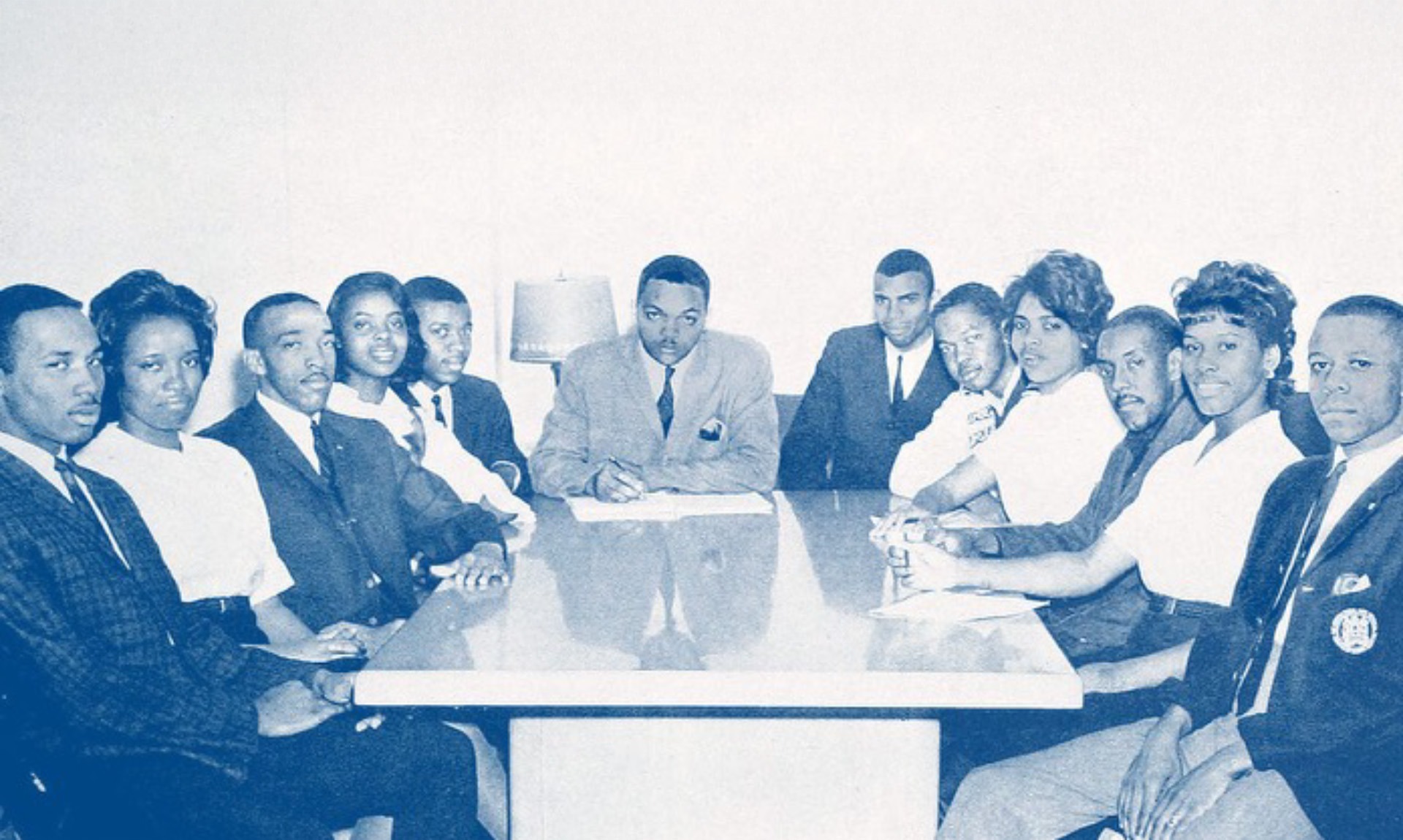
Jelani Favors reflects on how Jesse Jackson’s years at North Carolina A&T helped shape the self-love, service, and leadership that would define his public life.

When Rev. Jesse Louis Jackson arrived in Greensboro to enroll at North Carolina A&T State University, a historically Black college and university in 1961, he was 19 years old. He was a transfer student, having first attended the University of Illinois during his freshman year.
As a star football player from South Carolina, Jackson was taunted by racial slurs on campus in Illinois and limited in what he could do and be on the field of play as an athlete. In a 2006 interview, Jackson recalled that Black students were not expected to become student body presidents, were not expected to live beyond certain parts of town, and were conditioned to live under the constraints of racial segregation.
The hostility Jackson encountered as a student-athlete pushed him to change his environment. During a train ride home after his first year in college, he witnessed the camaraderie and love shared among HBCU students as they boarded segregated railway cars. That experience led him to call North Carolina A&T football coach Bert Piggott and request a transfer. A&T became the place where Jackson flourished. As a 1964 graduate, his character and his unshakable belief that he too was somebody were formed in the classrooms and on the campus grounds of the nation’s largest Black college while the modern civil rights movement unfolded in America.

In his multi-award-winning book Shelter in a Time of Storm: How Black Colleges Fostered Generations of Leadership and Activism, Jelani Favors argues that generations of Black college students encountered the same kind of environment that welcomed Jackson in Greensboro. It was an environment that promoted idealism and provided a safe space that upheld their dignity and humanity. Favors describes this pedagogy and ethos as the “second curriculum.” Beyond equipping students with the formal skills and knowledge associated with academic study, Black colleges also armed them with the intellectual tools to identify and challenge bigotry and systemic racism.
Upon his arrival at A&T, a new reality opened before Jackson. It cultivated the importance of character, civic engagement, and service, while also reinforcing a communal belief in self-love among African American youth. Jackson later described it as a complete reversal of what he had known before, a world that affirmed what Black people could do and who Black people could become.
Jackson’s gift for poetic and rhetorical framing of the freedom struggle was also nurtured at A&T. He recalled being mentored by renowned theologian and former A&T president Samuel DeWitt Proctor, whose oratory left a deep impression on him. Jackson remembered that Proctor could speak with force, clarity, and relevance, articulating the issues of the time in a way that made public leadership feel alive and urgent.
When Proctor delivered the keynote for the school’s fall convocation in 1963, he made space for Jackson, then a student body leader, to address his peers. That gesture continued to build Jackson’s confidence and equipped him with practical tools for leadership and service. According to the student newspaper, Jackson acknowledged in that speech that a social revolution for justice for all Americans was underway. He ended by calling students to endure and remain vigilant until victory was won.

Jackson’s college experience reinforces the idea that leaders and public servants are not simply born. They are formed. Black colleges have continued to punch above their weight, producing transformative leaders across multiple fields while also serving as economic anchors for their communities. Yet their most significant contribution may be their role as incubators of movements and leaders who have carried moral clarity into moments when the nation needed it most. Jesse Jackson’s evolution as a scholar and campus leader at North Carolina A&T reflects that legacy.
Historically Black colleges and universities remain among the most fertile grounds for instilling self-love, a sense of service, and strength of character in young people. Jackson’s story stands as one more reminder that Black educational spaces have never been just about degrees. They have also been about dignity, formation, and the making of leadership for the struggle ahead.
About the Author: Jelani Favors is vice president of the Frederick D. Patterson Research Institute at UNCF. A native of Winston-Salem, North Carolina, he earned a bachelor’s degree in history from North Carolina A&T State University, a master’s degree in African American studies, and a Ph.D. in history from The Ohio State University.







news via inbox
Don’t miss a moment—subscribe now and be the first to know when new stories drop.